
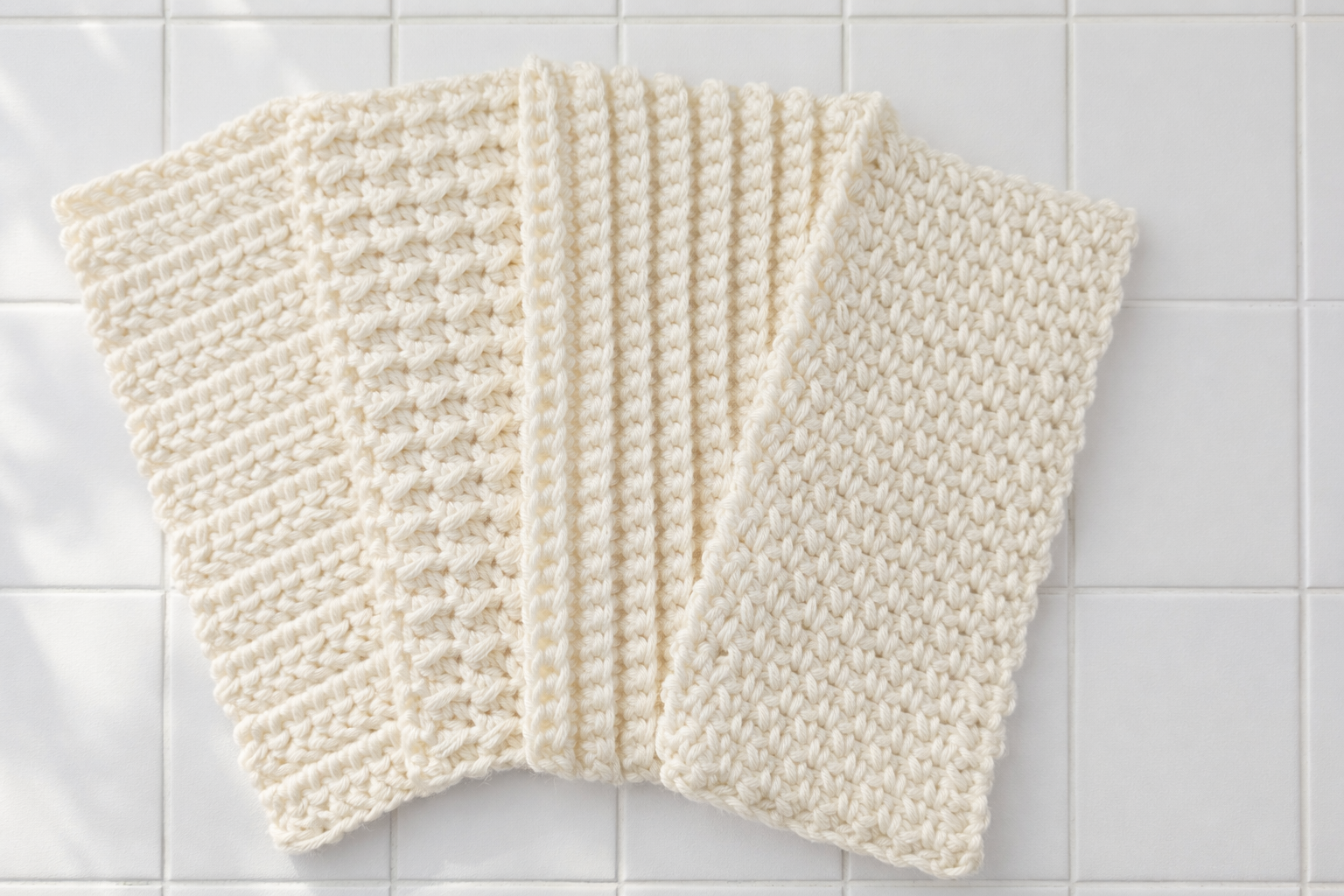
A kitchen towel is not decorative first — it is functional first.
It absorbs water.
It withstands repeated washing.
It maintains structure over time.
The stitch you choose determines whether your towel will soften beautifully or lose integrity after a few cycles in the washing machine.
Not all crochet stitches are suitable for kitchen textiles. Some are too open. Some are too elastic. Some are visually appealing but structurally weak.
This guide focuses on stitches that create durable, structured, washable kitchen towels.

What Makes a Good Kitchen Towel Stitch?
Before choosing a stitch, define the criteria.
A well-designed kitchen towel should be:
Absorbent
Cotton fibers must sit close enough together to retain moisture.
Structured
The fabric should hold shape without stretching excessively.
Balanced in Density
Too tight, and the towel becomes stiff.
Too loose, and it becomes decorative rather than practical.
See this article for more information on textile densities.
Wash-Resistant
Stitch definition should remain after repeated laundering.
Durability is not about thickness alone.
It is about stitch behavior.
The Best Crochet Stitches for Durable Kitchen Towels
1. Even Moss Stitch

The even moss stitch creates a subtle, balanced texture.
It alternates structure in a way that distributes tension evenly across the fabric. The result is a textile that feels soft yet controlled.
It works well with towels due to its moderate absorbency and elegant surface texture. As it has an excellent tension distribution, the distortion afer washing is quite minimal.
It is particularly suitable for minimalist, modern kitchen textiles where texture should remain understated.
2. Half Double Crochet
Half double crochet offers a smooth surface and moderate flexibility.
It produces a slightly softer towel while maintaining enough density for daily use, making it a balanced drape.
For larger towels makes more sence as it is faster to work than a single crochet with a clean vertical definition. And as it is suitable for a medium-weight cotton, doesn’t add too much weight.
As already said, it is really well-suited for larger towels where softness matters as much as structure.
3. Single Crochet (Back Loop Variation)
Standard single crochet is already compact and durable.
When worked in the back loop only, it develops subtle horizontal lines while maintaining structure. That creates a strong shape retention.
It works well as it creates structured edges that make it wash-resistant for a high durability.
This stitch is ideal when you want a refined, architectural look with long-term resilience.

4. Tight Double Crochet (With Reduced Hook Size)
Standard double crochet is often too open for kitchen use.
However, when worked with a slightly smaller hook and consistent tension, it can create a structured yet breathable fabric.
It works well for larger towel formats as double crochet makes it faster to create.
Although it has a moderate absorbency, the balanced thickness makes it a flexible lighter tissu.
The key is reducing hook size to prevent excessive openness.
5. Herringbone Half Double Crochet

This stitch introduces diagonal tension lines that create both visual refinement and structural stability.
It feels modern and intentional without becoming decorative.
The strong cohesion between stitches creates an elegant surface that holds shape after laundering.
For collections built around cohesion and visual continuity, this stitch performs beautifully.
Crochet Stitches to Avoid for Kitchen Towels
Some stitches are better reserved for decorative pieces.
Avoid:
Large lace patterns
They reduce absorbency and structural integrity.
Wide mesh stitches
They distort easily after washing.
Highly layered textured stitches
They may feel beautiful but can trap moisture and dry slowly.
Kitchen textiles benefit from restraint.
Choosing the Right Yarn for Durable Crochet Towels
Even the best stitch will underperform if paired with the wrong fiber.
For durable kitchen towels:
Choose:
- 100% cotton
- Cotton-linen blends
- Structured plant-based fibers
Avoid:
- Acrylic
- Fuzzy yarns
- Stretch-heavy blends
The goal is stability and performance.
Designing Kitchen Towels that Last
A durable kitchen towel is not the result of a random stitch selection.
It is the result of:
- Controlled density
- Thoughtful fiber choice
- Consistent tension
- Wash testing
Durability is a design decision.
At CABUFIL Studio, each textile is tested after laundering before becoming part of a collection. Structure must remain intact.

Final Thoughts
Crochet kitchen towels can be both refined and functional.
When stitch density and fiber selection align, the result is a textile that performs daily while maintaining visual clarity.
The most successful designs are rarely the most complex.
They are the most controlled.
FAQ
What type of yarn is best for kitchen towels?
100% cotton is the best type of yarn for crocheted kitchen towels.
What is the best crochet stitch for a kitchen towel?
Half double crochet or Even moss stitch are really good choices for kitchen towels as they give a medium density textile capable to absorve water well.
Leave a Reply