
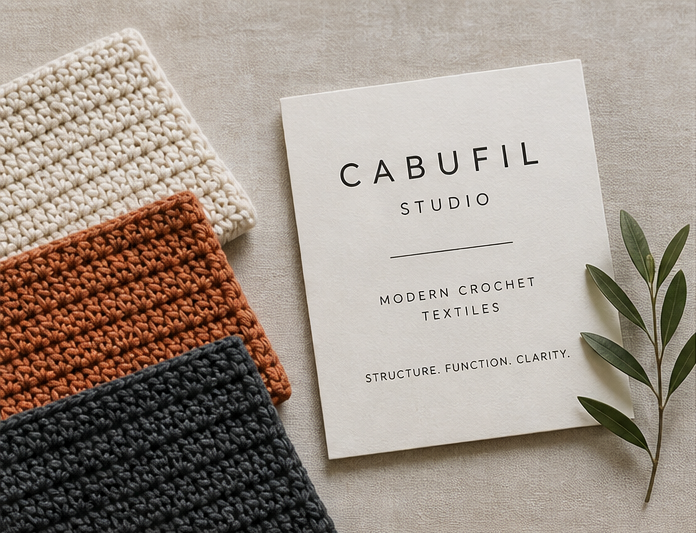
Rethinking Crochet as Design
Crochet is often understood as a craft rooted in tradition. It is associated with decoration, intricate motifs, and objects that carry a strong sense of nostalgia. While this perspective reflects an important part of its history, it does not define its full potential.
Cabufil Studio was created from a different point of view. Instead of approaching crochet as a decorative practice, it is considered here as a design medium. The intention is not to reproduce familiar patterns, but to explore how crochet can exist within modern interiors through structure, proportion, and clarity. This vision is further explored in the article Crochet Kitchen Textiles for a Modern Home, where the relationship between handmade objects and contemporary spaces is examined in depth.
This shift changes the role of crochet. It moves from ornament to function, from hobby to design language.
A Structured Approach to Crochet

At the core of Cabufil Studio lies a structured approach to textile design. Each crochet pattern is developed with attention to balance, repetition, and proportion rather than complexity.
This approach begins with the simplest elements. Basic stitches are not seen as limitations but as tools. When used with precision, they create surfaces that feel stable and intentional. If you are interested in how stitch selection directly impacts the final fabric, the article Best Crochet Stitches for Durable Kitchen Towels expands on this idea through practical examples.
The repetition of a stitch becomes a way to establish rhythm, while small variations introduce depth without disrupting the overall composition.
Structure is not only visual. It also defines how a piece behaves in use. A crochet kitchen textile must hold its shape, respond to daily handling, and maintain its integrity over time. The influence of material and yarn choice on this behavior is explored in How Yarn Weight Changes Crochet Fabric, where different weights are analyzed in relation to texture and function.
Crochet for Modern Interiors

Designing crochet for modern interiors requires a different sensitivity. In a contemporary space, objects are expected to integrate rather than stand out. They must contribute to a cohesive environment defined by clean lines, neutral tones, and carefully chosen materials.
Cabufil Studio approaches crochet kitchen textiles as part of this environment. A dishcloth, a towel, or a placemat is not treated as an isolated object, but as an element within a broader composition. For inspiration on how these pieces can be styled and combined, you can explore Crochet Kitchen Textiles for a Modern Home, which presents a cohesive vision of textile use in everyday spaces.
This is why color palettes remain restrained. Soft ecru, terracotta, and charcoal are used not for decoration, but to define structure and create subtle contrast.
The First Collection: Line & Hearth

The first collection, Line & Hearth, introduces this design language through a series of modern crochet kitchen textiles developed as a cohesive system. Each piece is designed to function independently while also contributing to a unified visual identity.
The collection includes essential kitchen elements such as dishcloths, towels, placemats, and coasters. Rather than treating these items as separate projects, they are conceived as variations within the same structure.
If you would like to explore pattern examples that reflect this aesthetic, the article 8 Modern Crochet Dishcloth Patterns (Minimal & Stylish Ideas) presents a curated selection aligned with this approach, including the Cabufil Studio free pattern.
Simplicity as Precision
One of the defining principles of Cabufil Studio is the idea that simplicity requires precision. A minimal crochet pattern leaves little room for distraction. Every detail becomes visible, from the regularity of the stitches to the alignment of edges.
This level of clarity demands a careful approach to both design and execution. Tension, stitch choice, and finishing techniques all contribute to the final result. The goal is not to create complexity, but to refine simplicity until it feels complete.
In this context, modern crochet is not defined by how much is added, but by how much can be reduced without losing intention.
A Digital-First Design Studio
Cabufil Studio operates as a digital-first crochet design studio, focusing on patterns that can be accessed and used globally. This approach allows for a scalable model where each design becomes part of a growing catalogue.
Digital crochet patterns offer flexibility and accessibility. They allow makers to engage with the designs at their own pace while maintaining a consistent level of quality.
If you are just starting your journey with Cabufil Studio, the free modern crochet dishcloth pattern is the best entry point, offering a first experience of this structured design approach.
Building a Cohesive Textile Language

The long-term vision of Cabufil Studio is to develop a cohesive textile language that can be applied across different objects and collections. Each pattern is not an isolated design, but part of a broader system.
As new collections are introduced, they will continue to explore the relationship between structure, material, and color. The goal is to create textiles that are both functional and visually coherent, capable of integrating seamlessly into modern living spaces.
Final Thoughts
Cabufil Studio is built on the idea that crochet can evolve without losing its essence. By focusing on structure, clarity, and intention, it becomes possible to create patterns that feel both contemporary and timeless.
For those who want to go further, exploring related articles such as How to Choose Yarn for Crochet Projects (With a Focus on Structure) will deepen your understanding of the principles behind each pattern.
FAQ
What makes Cabufil Studio different from other crochet brands?
Cabufil Studio focuses on modern crochet design for interiors, emphasizing structure, minimalism, and cohesive collections rather than decorative or traditional styles.
What is a structured crochet pattern?
A structured crochet pattern is designed with attention to repetition, proportion, and fabric behavior. It prioritizes clean lines and functional performance over decorative complexity.
Are Cabufil Studio patterns beginner-friendly?
Many patterns are accessible to beginners, as they rely on simple stitches. However, they require attention to tension and consistency to achieve a refined result.
What kind of projects does Cabufil Studio offer?
The studio focuses on crochet kitchen textiles and interior pieces, including dishcloths, towels, placemats, and other functional objects designed for modern homes.
Start Your Modern Crochet Journey
If this approach to crochet resonates with you, the best way to begin is by experiencing it firsthand.
The Cabufil Studio free pattern is designed as an introduction to this structured method. It allows you to explore how simple stitches, thoughtful proportions, and carefully chosen materials come together to create a textile that feels both functional and refined. It is not just a project, but a starting point.
From there, you can continue building your understanding through the collection of modern crochet patterns and in-depth articles available on the studio. Each piece and each guide is part of the same system, helping you develop consistency in your work and clarity in your design choices.
If you are curious about how materials influence your results, you can explore how yarn weight shapes crochet fabric. If your focus is on technique, learning how to create clean color transitions will refine your finish. And if you are looking for inspiration, curated selections of modern dishcloth patterns will help you see how these principles translate into different designs.
Crochet, in this context, becomes more than a finished object. It becomes a process you can understand, control, and evolve.
Begin with the free pattern, continue with the collection, and gradually build your own cohesive textile language.
Leave a Reply